
New architecture program teaches students how to design with Indigenous principles in mind

Imagine a Tempe Town Lake free of concrete, its banks lush with native creosote and wildflowers, with winding dirt paths.
That visualization was created by a student who applied Indigenous principles to a design problem. Noor Alzuhairi is in the first cohort of the Indigenous placekeeping and design master’s degree program at Arizona State University. The degree, in The Design School, debuted last fall.
The program focuses on using traditional knowledge from Indigenous cultures around the world — methodologies, worldviews and systems — as a way to approach design issues.
“I looked at different energy systems that were there, water systems and human systems,” Alzuhairi said.
“The water’s controlled — it’s being pumped. The water is restricted but it’s a living system. How do you challenge that?”
Tammy Eagle Bull, a professor of practice in The Design School, is the first Native American woman to become a licensed architect in the U.S. She’s the director of the degree program, which was founded by Wanda Dalla Costa, an Institute Professor of architecture and the first First Nations woman to become a licensed architect in Canada.
Eagle Bull said the degree program, which has more than 70 students, doesn’t focus on just Indigenous people or projects.
“It’s about using the traditional knowledge that we have of ecological systems, and of existing on this land, which wasn’t considered scientific in the past because it wasn’t written down,” she said.
“It’s about using the Indigenous ways in everyday design — not only use of materials, how not to deplete the Earth, but also design strategies like passive ways of heating and cooling and existing in climates, especially in Phoenix.
“There have been people living here for thousands of years in this very harsh climate.”
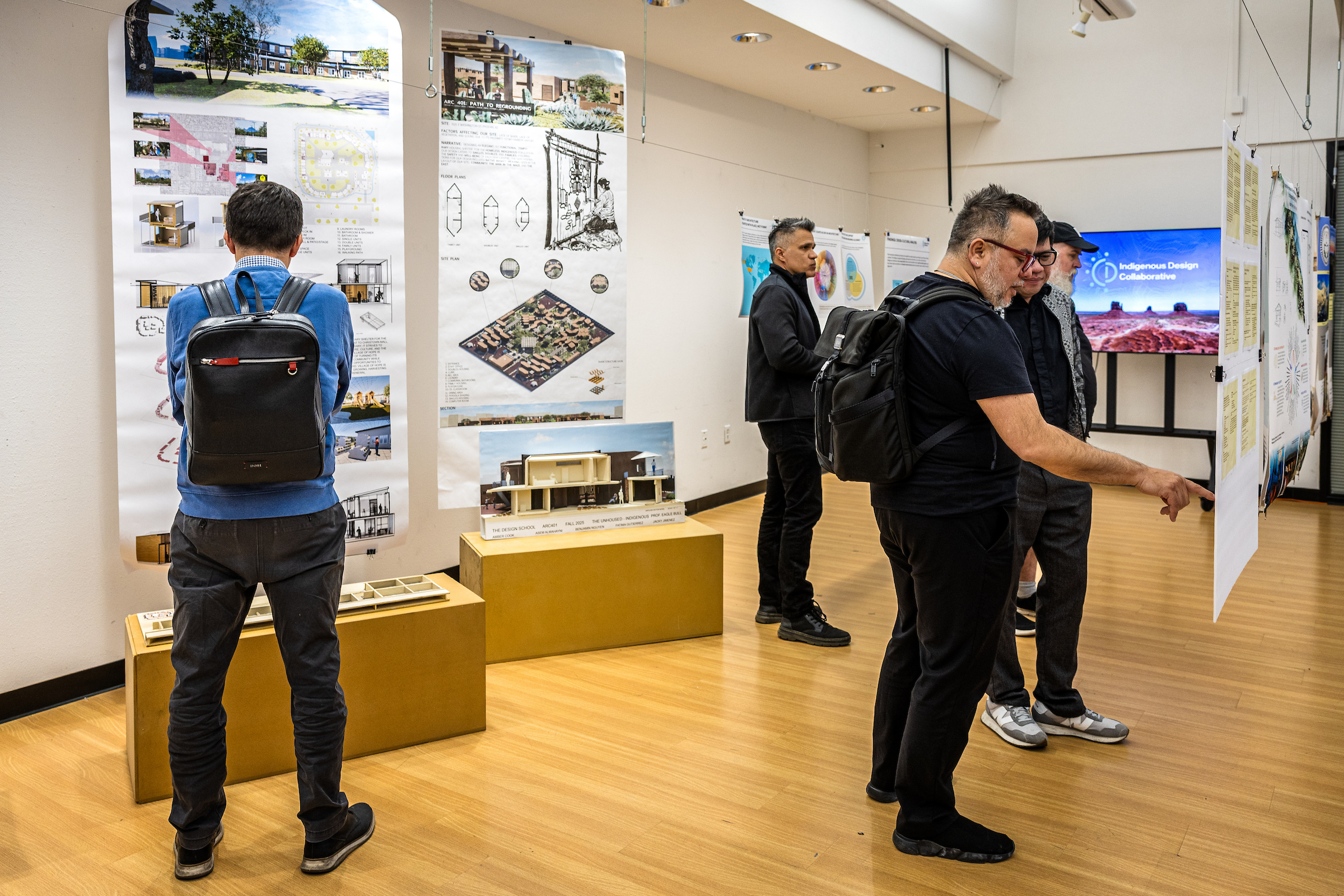
Students in the studio courses recently presented their projects, in which they considered how architecture can support well-being through a cultural lens.
One group of students designed temporary housing units, working with Native American Connections, a nonprofit that provides housing and health services. Their designs incorporated aspects of spirituality. For example, a fire pit in the shelter community would be a place of belonging.
“We looked at historic Indigenous designs and we did our best to implement them going forward,” said Jake Santos, a fourth-year undergraduate student in architecture, who took one of the studio courses in the master’s program.
“One of the best parts was that people were not only willing but very excited to help. We had the best critiques, we visited multiple sites and everyone said, ‘Please let us get involved. Let us ask questions.’”
Fourth-year architecture student Parker Ribeiro-Hurst said: “For me it was just more about recognizing, as an architect, that the land is one of the most significant parts in the process and recognizing the original people who have been on that land is important.”
Neeta Bhuwaji, who is from Nepal, said she joined the program because she was always inclined to see how culture can be part of design.
“It makes the design more meaningful and more personal, and provides a good human experience,” she said.
She was also inspired by her love of nature videos.
“I would see how Indigenous people take care of the land and connect with the land. That inspired me to learn more about Indigenous thinking and how I can bring that thinking into the inside,” she said.
Alzuhairi created her Tempe Town Lake project using AI to produce the images based on her research.
“It’s these nice images of a free-form riparian site with native plants and animals, diminishing the whole idea of concrete,” she said.
Alzuhairi worked with Dalla Costa, who said that when working with AI, it’s important to include principles from Indigenous people.
“I shared with the students that we got left out of the history books once because we had an oral culture. We want to make sure we get in there this time and that our words are embedded within this brain of AI because we know it’s not going to go away. So we had better start course-correcting it,” she said.
A family legacy
Eagle Bull credits her upbringing by her Lakota parents in South Dakota for her groundbreaking journey.
“Both my parents made a conscious decision to raise their family off the reservation so that we would have better opportunities, but we still had very strong ties to the Pine Ridge Reservation, which is where they’re from,” she said.
“As I got older, I started to notice the difference between the school, which was in poor shape, and the houses my cousins lived in and the house that I lived in.”
Her father worked in tribal education, collaborating with architects on building schools. He was frustrated by the process.
“They would hire non-Indigenous architects to come out and do a building in South Dakota and make it ‘Native looking.’ The floor plan would look like a buffalo or an eagle, and it was totally not functional as a school because there would be all these weird spaces but also no one could see the shape unless you were flying over in an airplane,” she said.
“He started talking to me a lot about architecture and how I could use that to help my community.”
Eagle Bull said that the students in the program learn about contemporary Indigenous architects and designers, including herself and Dalla Costa.
“Our work is very place-based. None of us has a style where you look at a building and go, ‘Oh, that’s Wanda’s because it looks like her other building over there.’
“That comes from this worldview and having been raised in our cultures with these values and beliefs about the Earth.”
Dalla Costa said the launch of the degree program is the culmination of everything she’s worked toward since coming to ASU in 2016. After she came, she founded the Indigenous Design Collaborative, in which students partner with Indigenous communities on life-centered designs.
“There are more Indigenous students here than any other university I have taught in. And that makes this a really rich place for this line of study to rise up in a powerful way,” she said.