T H E M E T H O D
MetaDiagram™ is the method that helps you see a complex system as a whole. A discipline drawn from architecture and systems thinking, taught through the signature workshops, applied to companies, careers, and lives.
meta | prefix | ˈme-tə | above; beyond; the higher view
diagram | noun | ˈdī-ə-ˌgram | a drawing of how parts connect
metadiagram | noun | ˈme-tə-ˌdī-ə-ˌgram | the drawing that holds the whole system at once
WHAT IS METADIAGRAM™?
A Bird's-Eye View of Any System
The systems thinking tradition has long observed that a system can be changed only from within, but understood only from outside. Inside the system, the agent has the power to act; outside, the observer has the perspective to see. These are different kinds of knowing, and most strategic work conflates them, because no internal agent can perceive every function of every part at once.
MetaDiagram™ is the method that produces the necessary distance. The metadiagram itself is the bird's-eye view, an artifact in which every part, relationship, and force can be examined together, recognized as patterns, and carried back into the system as informed action.
The method draws on two lineages: architectural drawing, which has used the bird's-eye view as a problem-solving tool for thousands of years, and systems thinking, which established the grammar of dependencies, feedback loops, and emergent behavior in the mid-twentieth century. MetaDiagram™ is the contemporary synthesis of the two.
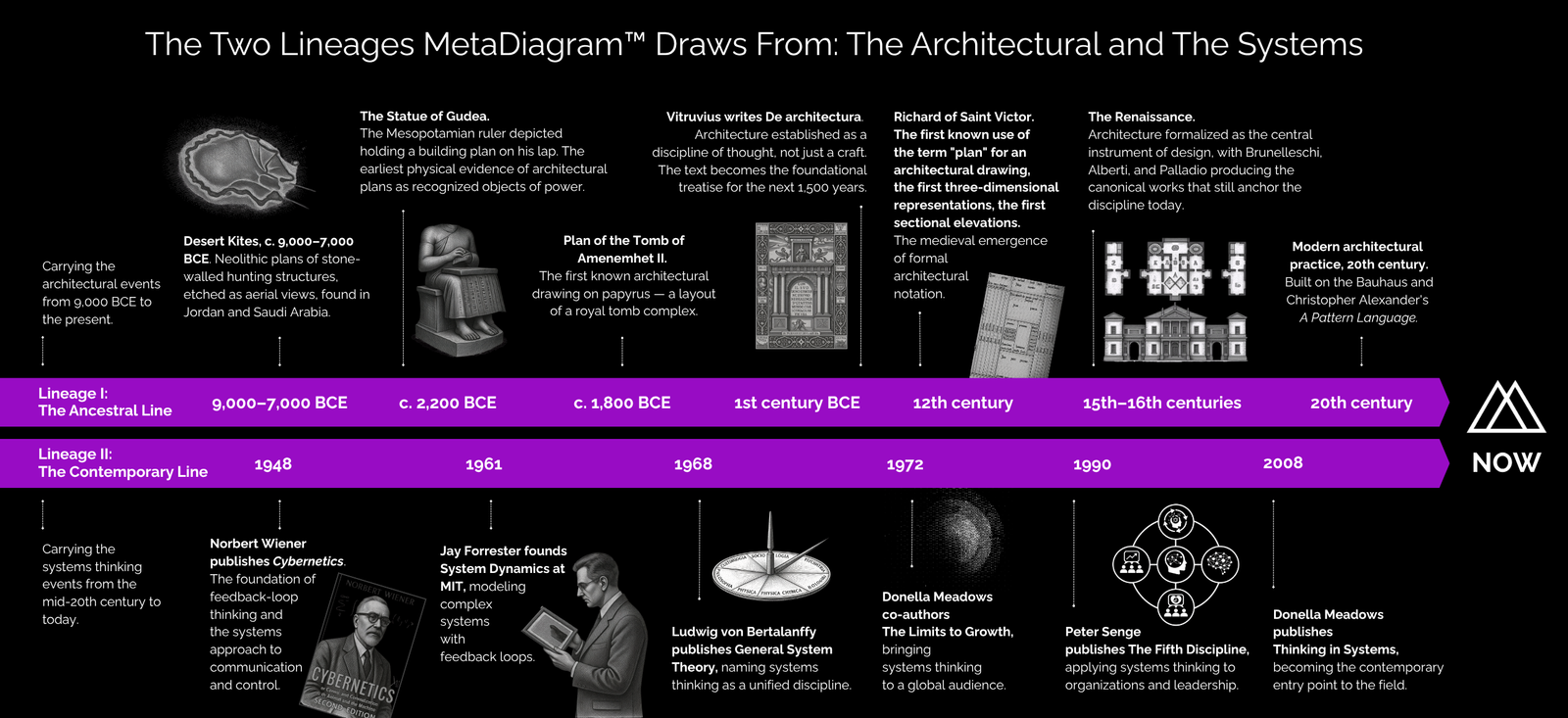
Every method has a lineage. MetaDiagram™ has two.
The first is ancient — the architectural discipline of holding every force acting on a site inside a single drawing, refined across nine thousand years from the Neolithic plans of the desert to the Bauhaus and Christopher Alexander's pattern language.
The second is recent — the systems thinking that emerged in the mid-twentieth century, when a generation of researchers began to see that what matters most in any complex system is not its components but the relationships between them. The two traditions developed independently, in different languages, for different purposes.
MetaDiagram™ is the contemporary practice that joins them — a method for drawing systems whole, the way architects have always drawn buildings. Meta-disciplines like this one were once the privilege of universities and well-funded research labs. In the age of AI, this kind of thinking finally becomes available to individuals, and to anyone working on a system complex enough to outgrow a list.
THE CORE PRINCIPLES OF THE METHOD
Three principles for every metadiagram.
01
CORE PRINCIPLE
Every map works within its focus.
Every map is anchored to a specific question, decision, or goal. The focus is established before the start, and it determines what belongs on the map and what remains outside.
Drift from the focus produces unpredictable results: conversations that wander, and conclusions the original question cannot validate.
02
CORE PRINCIPLE
Every map exists
in layers.
Every entity and vector on a metadiagram is a layer. Layers can be isolated, toggled, or grouped to test how the system behaves under different conditions. Each element must be filed in its correct category for these toggles to produce meaningful results. Layering is what converts the map into a working instrument.
03
CORE PRINCIPLE
Every map lives within its time.
A metadiagram is a time-bound artifact. It moves through four recognized states: Draft, Active, Replaced, and Archived.
The current state must be recorded as part of the artifact. Without a recorded state, a metadiagram cannot be reliably interpreted or compared against successor versions.
THE ORDER OF THE METHOD
Building a Metadiagram
A metadiagram is built in nine phases. Some are foundational and must be completed in order for the map to make logical sense. Others are creative phases that allow for following insight, adding references and inspirational details, returning to earlier layers, and simulating relationships in different combinations.
Building a metadiagram is not a mechanical process. It is a thinking process. The method exists to give the brain a domain to see relationships, test connections, simulate possible configurations, and let the system reveal patterns no other approach can show. The order below is the structure that makes this thinking possible. The creative phases are where the magic actually happens.
Phase 01 — Name the Map.* Apply the formal naming convention and mark the metadiagram as Draft.
Phase 02 — Name the Focus.* Articulate the question, decision, or exploration that the metadiagram is being built to address.
Phase 03 — Select the Legend.* Choose the vocabulary of entities, lines, and layers that this metadiagram will use.
Phase 04 — Place the Primary Entities.* Position the Protagonist, Antagonist, and Goal on the working surface.
Phase 05 — Draw the Primary Relationships.* Establish the lines connecting the three primary entities to each other.
Phase 06 — Add the Secondary Entities.* Place Allies, Obstacles, Catalysts, Stakes, Context, and External Forces as required by the focus.
Phase 07 — Draw the Secondary Relationships. Establish the lines connecting secondary entities to primary entities and to one another.
Phase 08 — Add the Intuition Layer. Surface what is felt but not yet analytically defended, drawn in the color of intuition.
Phase 09 — Reconcile the Layers and Mark as Active.* Audit every element for correct layer assignment and transition the metadiagram from Draft to Active.
*Phases marked with an asterisk are foundational and must be completed in order.
Unmarked phases are creative and allow flexibility in sequence and timing.
VOCABULARY
A Language for the MetaDiagram™
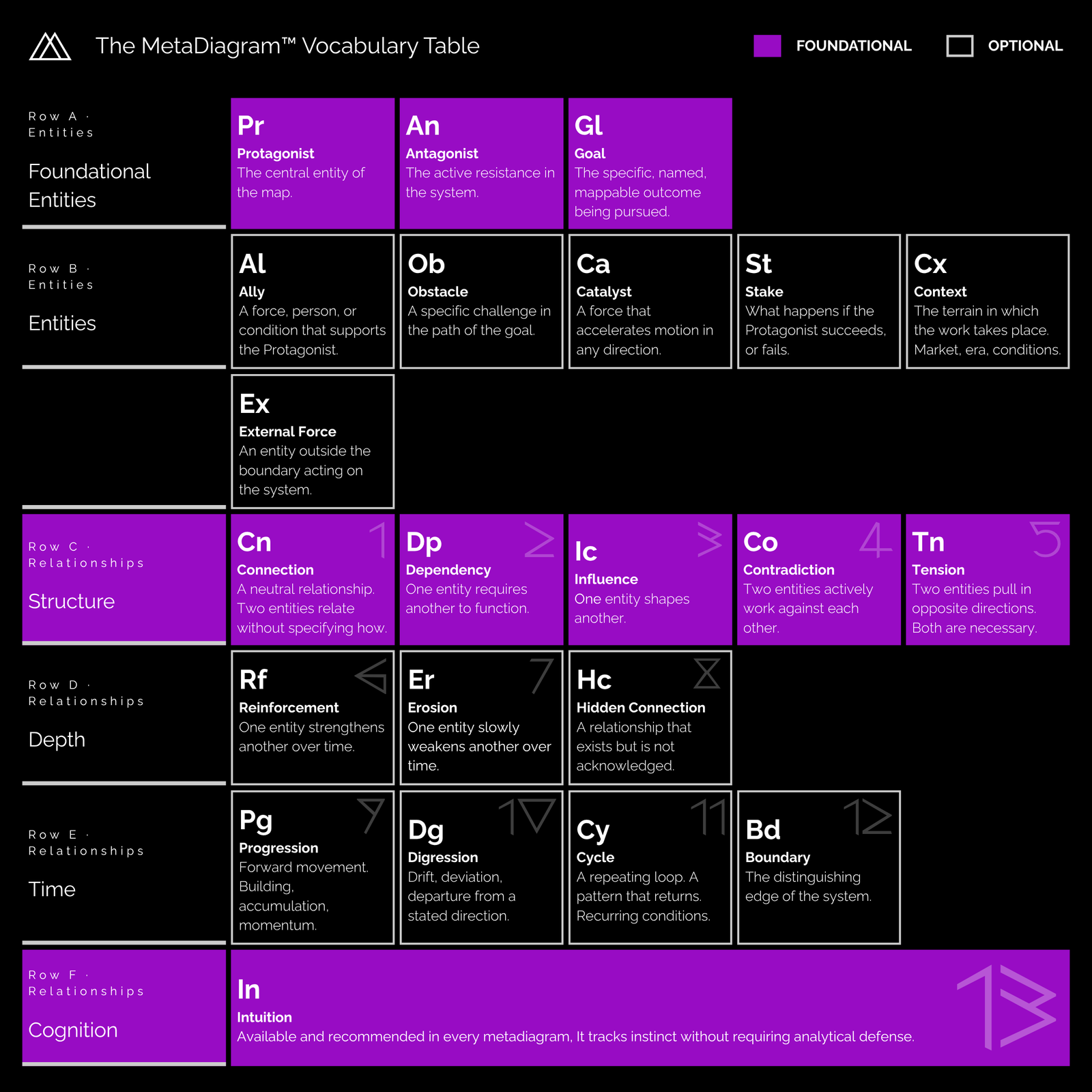
The method requires a special system of notation. Entities are the nouns of the map: the people, decisions, conditions, and goals placed on the working surface. Vectors are the verbs: the ways those entities relate, depend, oppose, reinforce, or shape one another. Together they form the general vocabulary used in the MetaDiagram™ method.
The vocabulary is annotated in the manner of a periodic table because in the process of creation, thinking and flow speed matter, and elements must be placed on the map rapidly. The notations are compact enough to fit on the working surface. Pr→Gl (Cn) describes a relationship in seven characters where prose would need a sentence. The table is designed to keep the vocabulary accessible at a glance.
The vocabulary presented here may evolve over time as the practice grows and new elements are introduced.
The table is published on the website for the convenience of those who have taken a MetaDiagram™ workshop and may wish to reference it in their own work.
WAYS TO ENGAGE
Stay curious. Explore the work. Find your way in.
NEWSLETTER
Occasional letters on the method and the practice. No frequency promised, no inbox crowding.
CULTURE INFUSION
A corporate engagement on values, hiring, and retention — designed and facilitated for each client.
INDIVIDUAL WORKSHOPS
Small-group sessions announced exclusively to the waitlist, or designed for private events.
METADIAGRAM™