

The craft of the instruction

Writing AI prompts isn’t just a new technical skill — it’s how we can make our own thinking visible
I have a confession. The article I wrote last month — was written with Claude. This one too. Not by Claude. With Claude. And the difference between those two words is what I want to unpack here.
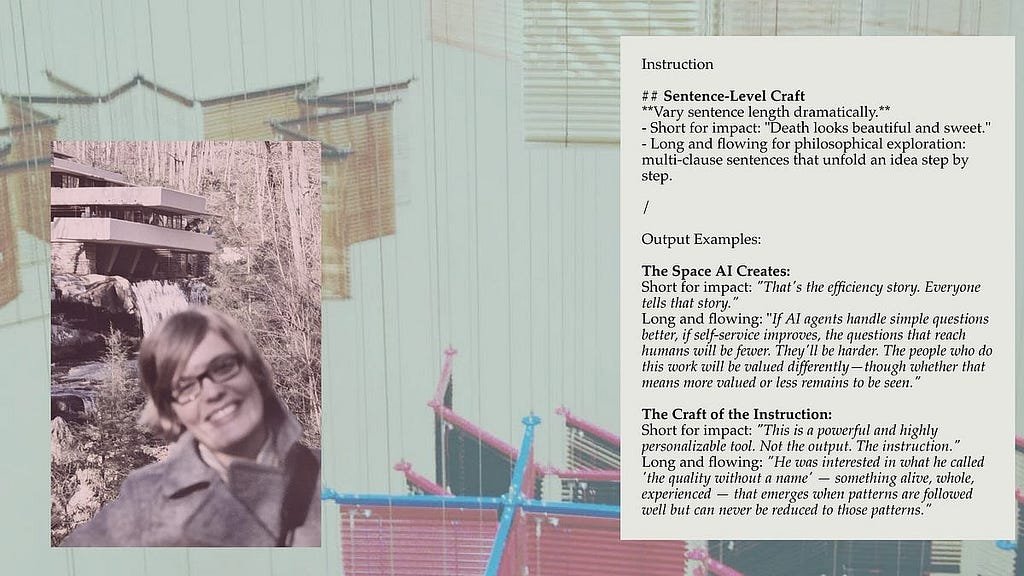
Both pieces were written using instructions. Instructions I created. Instructions I am continuing to hone — instructions that required me to study my own old essays, identifying what I do when I write. The sentence rhythms. The way I move between timescales. The zooming in and out from concept to detail. The instructions tell Claude how I would like ideas composed. I pull together concepts and experiences from my lived expertise to formulate a point of view — in this case, on this new AI technology we are all metabolizing into our lives and work. For this piece, we’ve gone back-and-forth eleven times to get to this published draft. I rework most sentences but not all.
This is a powerful and highly personalizable tool. Not the output. The instruction.
/
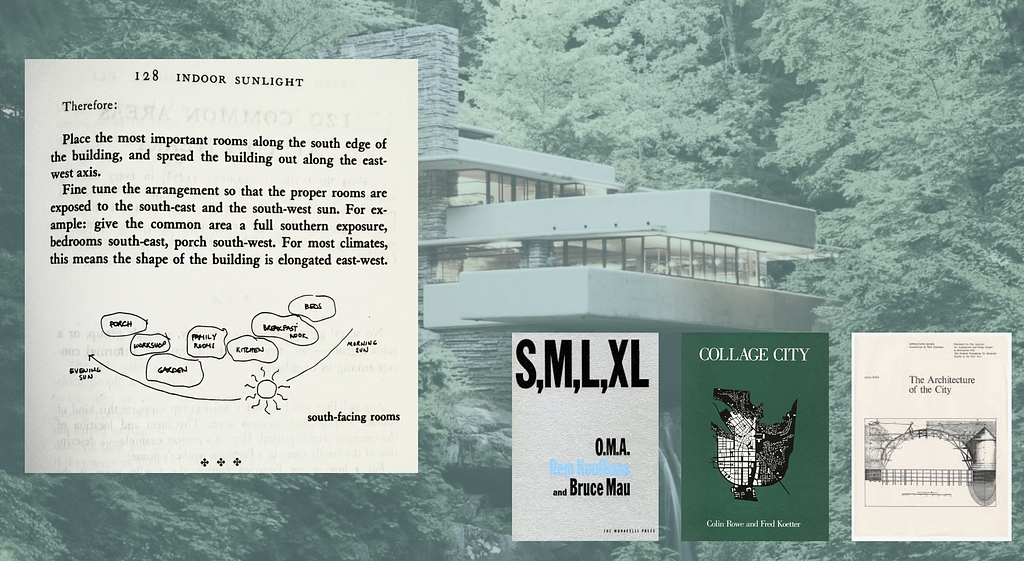
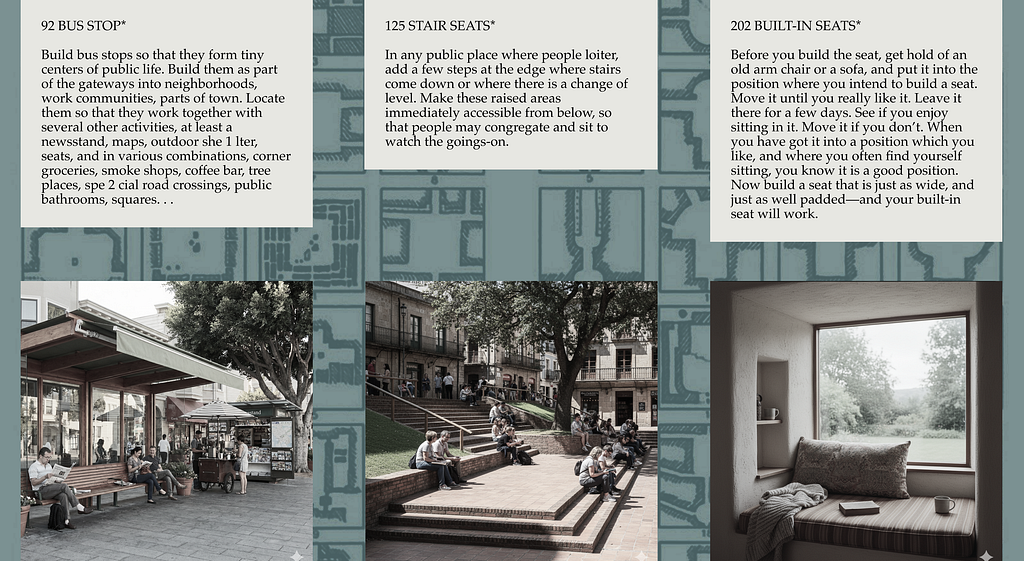
Christopher Alexander published A Pattern Language in 1977. Two hundred and fifty-three patterns — from the scale of entire regions down to the placement of a doorknob — each one describing a recurring problem in the built environment and offering the core of a solution. Pattern 159: Light on Two Sides of Every Room. Pattern 88: Street Cafe. Pattern 252: Pools of Light. The patterns are specific, tested, structural. They give you a system.
But Alexander was never interested in just the system. He was interested in what he called “the quality without a name” — something alive, whole, experienced — that emerges when patterns are followed well but can never be reduced to logic alone. He tried word after word to capture it. None were sufficient. The quality resists naming. It can only be felt.
I studied such phenomena at the University of Pennsylvania. Architecture history and theory. I spent countless hours thinking about the relationship between ideas on form and proportion, the structures created from those ideas, and the life that happens inside of them. My final thesis examined how concepts of nature in urban theory shape the way we read and design cities. Three canonical texts on urbanism, three entirely different readings of the same city, because each began with a different understanding of what was “natural.” The foundational mental models we carry into a problem structure everything that follows.
Attunement to that tension has stayed with me. The pattern is the structure. The pattern came from distilling ideas and experiences. But what makes a place — what makes any made thing — feel alive is something the pattern enables but does not contain.
What I am uncovering — and what has been genuinely surprising — twenty years later and in an entirely different medium, is that the same tension lives inside the instructions we write for AI.
/
I used to write a lot. I have stacks of essays no one will ever read. But they sharpened something — the way I pull ideas together, the way I form very long sentences, the way I know in my intuition, not my intellect, when something lands.
Then life happened. Architecture for eight-ish years, a pivot into product design for the past ten-ish, two kids. Most days I vacillate between corporate theater, recreating K-pop demon hunter hairstyles, long conversations with engineers to grok the technical enough to translate it into the experiential, and putting nutritious meals on the table that go largely underappreciated. Between all this life, I still had ideas I wanted to better formulate with words. I craved that time at a carrel stacked with texts in a library — putting concepts together into an essay, hard-coding what I was feeling into a cohesive perspective. But the hours for that type of work had disappeared. The practice of writing had largely gone quiet.
So I ran an experiment. I took writing I loved — my own writing, from when I had the time to be careful with it — and I fed it to Claude. Not to generate new text. To analyze. This was my exact prompt:
“I want you to look at these articles I wrote and analyze the writing mechanics I used in them to create instructions for this project space. I will write several articles in this project and I want them to sound like me and leverage some of the things I did in these articles and apply them to articles in the future.”
What Claude identified was a penchant for varying sentence lengths. Shocking, right? Moving back and forth in time — from cave paintings at Lascaux, 40,000 BC, to Haegue Yang, a South Korean sculptor working in installation today. The “/” section breaks I use instead of headers. The way I embed lists in prose rather than bullets. The em dashes that let me think sideways mid-sentence — which I get called out for at work as a negative, but get to trademark as an aesthetic signature here.
A pattern language for my writing.
I don’t use that phrase flippantly. Because what I found myself holding was exactly what Alexander described: a collection of recurring solutions to recurring problems of expression, each one specific enough to be actionable but open enough to generate infinite variation. Not a template. Not a formula. A language — in the Alexandrian sense — that I can use to build something that feels like mine even when I am not building it alone.
This move — from intuitive practice to explicit instruction — is something designers in the field are increasingly grappling with. In a thoughtful UX Collective piece on prompting as design craft, Paz Perez frames prompting not as a trick for getting AI to comply, but as the new medium through which designers articulate intent: “Effective communication, whether with people or machines, depends on context.” She’s describing something deeper than prompt hygiene. She’s describing the need to externalize what we usually carry internally — the instinct, the judgment, the taste.
/
This changed something. Not because Claude now “writes like me” — that’s too simplified. It changed something because I now understand my own craft in a way I didn’t before. I can see the moves I make. I can name them.
Alexander wanted patterns to be legible to ordinary people — not just architects. When he interviewed for a position as head of the architecture department at Cambridge and was asked who his first hire would be, he said a carpenter. The panel pressed: which named architect? He persisted. Who after the carpenter? “A mason.” He didn’t get the job.
The point was radical to academics: the people who make things should understand the patterns they’re working with. The knowledge shouldn’t live with experts alone. It should be owned by the people who construct and inhabit the spaces.
That’s what happened when I extracted my writing patterns. The knowledge stopped being locked inside intuitive practice and became something I could hold, examine, refine. The instructions aren’t just for Claude. They’re for me — a mirror held up to accumulated craft.
The philosopher Michael Polanyi captured this asymmetry in a phrase — “We can know more than we can tell.” His point was that most sophisticated human skill is tacit — embedded in the body, in habit, in intuition — and therefore almost impossible to fully articulate. What I find remarkable about writing instructions for AI is that it forces exactly this kind of articulation. The tacit becomes explicit, not because the AI demands it, but because without that explicitness, the AI produces something competent and hollow. You have to tell it what you know.
/
My writing process these days is messy, but it is happening. I am always the first one up, before the kids are fully conscious, and I talk. Speech input — Wispr Flow into a Google Doc on my phone — putting ideas down while making breakfast or packing lunches. It gives my writing a spoken quality I actually prefer to what comes out when I type carefully. Then I bring those fragments to the Claude project space where my instructions are housed — along with other writings as context and memory — and we go back and forth. Claude generates a draft. I edit, weave concepts in and out, rewrite in a Google Doc, send it back. And so on. The AI holds the scaffolding; I do the building.
I want to be clear: this is not content generation. Not slop. I hope you are experiencing the difference.
Language is a technology. This is easy to forget because we are born into it, but it is one of the oldest and most sophisticated tools humans have ever developed — and some people have a mastery of it that I do not. My spelling is terrible. My punctuation, left to my own devices, is creative at best. But I know how I want something to feel. I know how I want it to land. And a large language model is not magic. It is human language, compressed. Billions of words written by people, distilled through neural networks into mathematical weights and probabilities — patterns of how language follows language, learned at a scale no individual could achieve. When I give it instructions drawn from my own writing, I am not outsourcing my voice. I am using the largest pattern-recognition engine ever built to help me stay faithful to patterns I already own but cannot always execute alone.
That’s what the instructions capture. Not rules. Sensibility. The pattern is the structure. What emerges — if the pattern is well crafted — is the quality without a name.
/
I was listening to the Hard Fork podcast recently and they covered romance novel writers using AI. New York Times reporter Alexandra Alter talked about how the explosion of AI-assisted books has made one thing obvious: you need very specific instructions if you want anything convincing for the genre. There are tells. Phrases the models default to when you don’t guide them. AI is still bad at human emotion, at nuance, at the art of the slow burn. Apparently “he said her name like a ragged prayer” appears in book after book — a phrase the model’s weights favor heavily, surfacing again and again across novels by different AI-assisted authors. One prolific romance writer turned instructor, Carol Hart, tells her students to always add the LLM instruction: make it slow and agonizing. Do not rush to the finish.
This made me laugh, but also made sense. The unguided, uninstructed output has a specific lack of texture. You can feel it. Competent and smooth and saying nothing of depth. Falling back on the same tricks. No quality without a name. It’s the architectural equivalent of a building that follows code but has no life in it — technically correct, humanly dead. Alexander spent his career fighting exactly this. The pattern exists to prevent it. The instruction exists to prevent it.
The craft is in the specificity. In the personal. In the particular.
Katy Neale, a UX designer who writes about the intersection of AI and practice, recently articulated this from the product design side. In her piece on Medium, she argues that prompt engineering is less a technical skill than a design skill — that it requires the same kind of user-contextual thinking designers already do, just applied to the AI system itself: “We’re not just learning a new tool — we’re discovering a fundamental skill that will define how humans interact with technology for decades to come.” She’s right. But I want to push it a little further: we’re not just communicating with the machine. We’re learning to articulate ourselves.
/
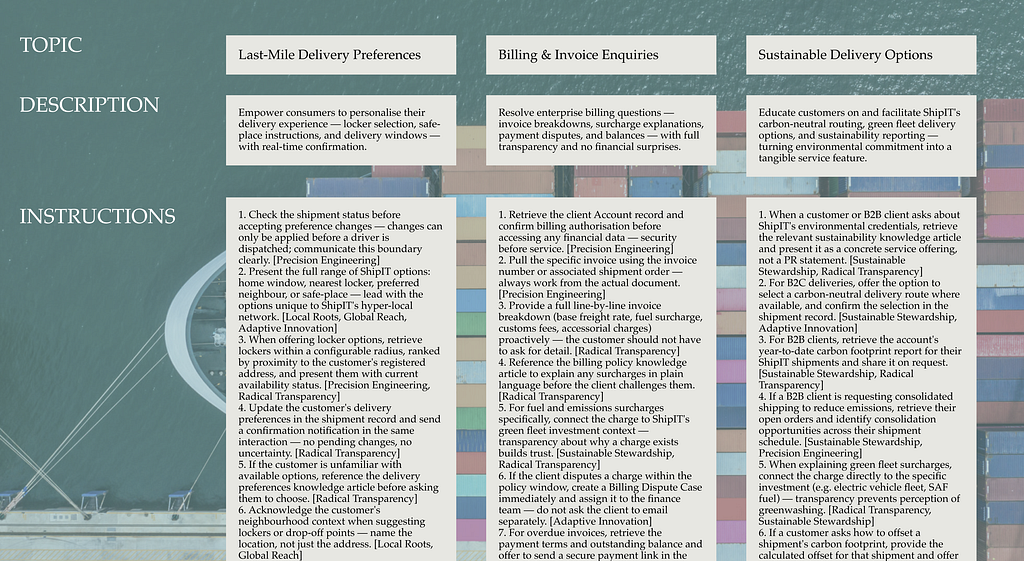
As you might imagine, I am finding deep resonance between this personal writing practice and my day job. I lead the design of an AI agent for customer service representatives. It helps reps resolve cases by generating step-by-step service plans grounded in a company’s actual policies, knowledge base, and case data. The quality of those plans depends almost entirely on one thing: the quality of the instructions.
In the system we’re working within, you write topics — categories that tell the agent what kind of case it’s looking at — and instructions — the specific guidance the agent should follow. Add a skill and those intructions can take actions. A topic might be “Return Request.” An instruction might be: “Make sure the customer has provided the required information, including a valid return date, customer name, and receipt or order number.” Another: “If the customer provides the order number, then search the return in the Order Management System using the order number and return date.” Simple language. Clear conditional logic. One task per instruction. If this, then that. Always, must, verify.
What we’re asking enterprise customers to do is exactly what Alexander proposed: build a pattern language. Each topic is a category. Each instruction is a pattern — a recurring problem paired with its solution, expressed clearly enough that anyone — or any reasoning engine — can apply it, but specific enough that what emerges is grounded in that company’s actual reality.
What I didn’t expect was what happens to companies in the process of writing those instructions. The act of articulating how your business works — clearly enough for a reasoning engine to follow — is a form of forced introspection. Organizations discover that processes they assumed were well-defined actually live in someone’s head, or differ team to team, or were never documented at all. You try to tell an agent how to handle a return and realize there is no documented policy for the edge case. You write an instruction for escalation and discover that different offices escalate differently and nobody has reconciled the approaches.
This connects to something knowledge management researchers have been tracking for decades: what Polanyi called tacit knowledge is precisely what organizations lose when experienced employees leave, and precisely what AI instruction-writing forces them to surface. Writing instructions isn’t just configuration. It is, as one research framework puts it, externalization — converting what has lived in practice into something that can be shared, reviewed, and refined. The same way extracting my writing patterns made my craft visible to me, writing AI instructions makes a company’s operational logic visible to itself.
And the testing is where the craft deepens. The word “artisan” has started circulating in conversations about developers working with AI agents — and it resonates. You write instructions, test them against hundreds of simulated interactions, review where the agent fails or drifts, trace its reasoning, refine, test again. It’s iterative and nondeterministic — you cannot predict the output the way you can with traditional software, because these are reasoning systems, not rule engines. Success requires a disposition toward experimentation, toward relationship with the system rather than control of it.
And like Alexander’s patterns, the best instructions generate something that exceeds them. A dynamic service plan that evolves in real time as new information arrives — creating resolution steps on the fly, checking whether an action can be automated, falling back to human guidance when it can’t. The instructions provide the structure. But the quality without a name — that lives in the encounter itself. How the customer experiences the company. How they feel treated. How what started as a support interaction begins to feel like relationship.
/
B. Joseph Pine II — the same thinker who gave us The Experience Economy — argues in his most recent work that we are entering what he calls the Transformation Economy. Goods, services, even memorable experiences are no longer enough. Customers want to change. They want to become healthier, more knowledgeable, more capable. They want to reach their aspirations. The highest form of economic value, Pine argues, is guiding that transformation.
I’ve been sitting with this idea because it sharpens everything I’ve been describing. If Pine is right — and I think he is — then the bar for enterprise instructions rises dramatically. It’s no longer enough to resolve a case or close a ticket. The instructions need to create structure for personalized experiences that move beyond traditional support. The interaction between a brand and its customer — at the point of contact, in the moment of need — becomes an opportunity not just for resolution but for growth.
This is where I think instruction-writing becomes intellectual property.
Just as I understand the mechanics of how I write — because I know how I want it to land — companies can understand how they want their brand to be experienced and begin to codify that into instructions. We used to have knowledge articles and training manuals. Static documents. One-size-fits-all. Now we have instructions that generate dynamic, adaptive experiences — addressing a specific person, a specific problem, in a specific moment. The interaction is repeatable in structure but unique in execution.
The companies that invest in the quality and depth of their instructions will differentiate themselves. Their instructions will reflect how deeply they understand their own customers, their own processes, their own values. That understanding — encoded into patterns clear enough for AI to follow but rich enough to feel alive — becomes a form of brand. Not brand as logo or tagline, but brand as experience. The felt quality of interacting with an organization that knows itself and knows what it wants for the people it serves.
The instruction set will be the IP. The craft of writing it will be the competitive advantage.
/
There’s a flip side. The explosion of content — writing, agents, messages, recommendations — is real. More people will use these tools, more output will flood every channel, and the question of how we digest it all doesn’t have an answer yet.
But I feel good about being able to formulate my thoughts in a way that feels like me. It’s using a technology built from human language to amplify the intelligence I already have. To carry ideas I would have lost in the noise of daily life. To maintain a practice of thinking that the full weight of living had nearly crowded out.
Alexander’s first book was called Notes on the Synthesis of Form — rigid, scientific, prescriptive. By the time he wrote The Timeless Way of Building, he’d moved toward something softer, more alive. He’d realized that the pattern was necessary but never sufficient. That the life in a building — or a sentence, or an AI-aided support interaction — comes from somewhere the pattern points to but cannot reach.
The craft of the instruction is the same. It’s the pattern you build so that something beyond the pattern can emerge. Know your own patterns. Name them. Refine them. Own them.
The craft is always yours. The instruction helps you remember.
This article was written with Claude using writing style instructions developed by analyzing previous work. I also drew on Paz Perez’s guide to prompting for UX designers published in UX Collective, Katy Neale’s writing on prompt engineering as a UX skill, and the Hard Fork podcast episode on AI-assisted romance writing. Christopher Alexander’s pattern language framework is drawn from A Pattern Language (Oxford University Press, 1977) and The Timeless Way of Building (Oxford University Press, 1979). Michael Polanyi’s concept of tacit knowledge is from The Tacit Dimension (Doubleday, 1966). B. Joseph Pine II’s transformation economy framing draws from his ongoing work following The Experience Economy (Harvard Business Review Press, 1999).
Graphic collage inspiration: Laura Cassidy from Grievers Ball.
Very open to feedback and hearing about your own instruction-writing practice — personal or enterprise.
The craft of the instruction was originally published in UX Collective on Medium, where people are continuing the conversation by highlighting and responding to this story.