MetaDiagram™ INSIGHT_002 June 12, 2026
The Smallest Room in the Mind
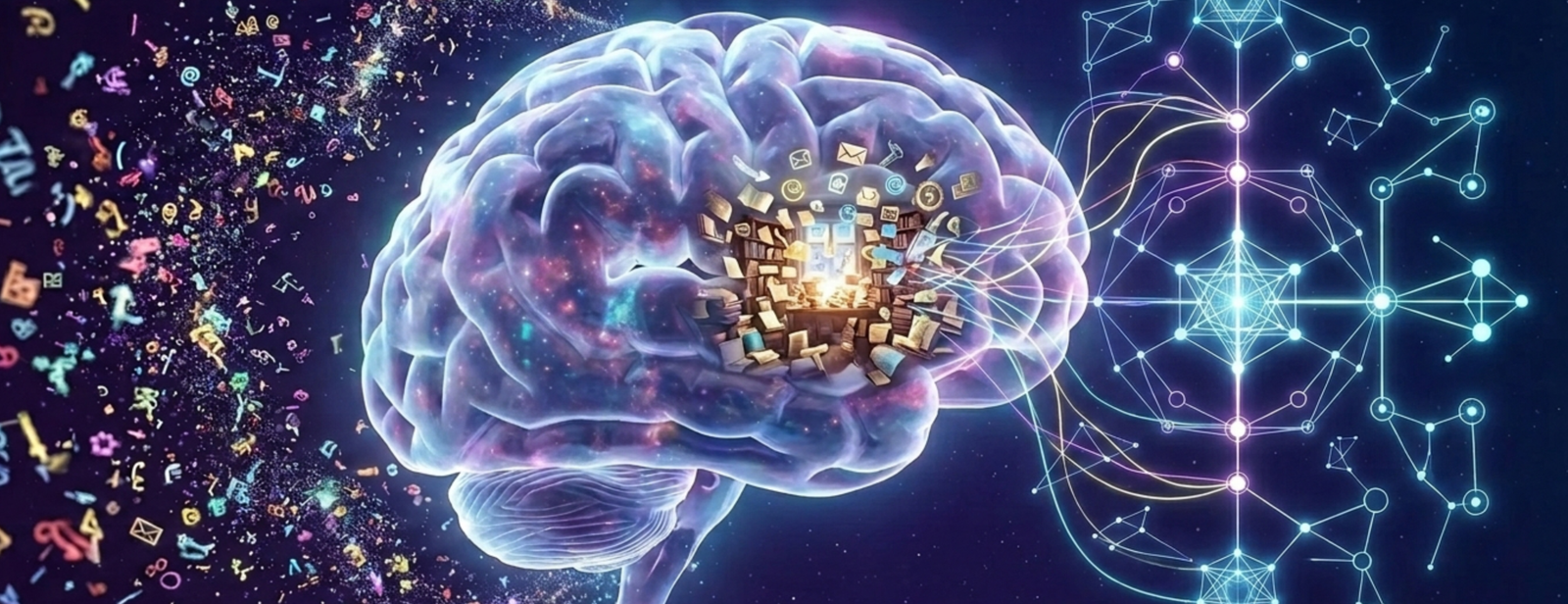
You are in the middle of your work, the day is far from over, and all of a sudden your brain refuses to take in one more thing. You need a moment of silence, a deep sigh, a short walk, maybe even a nap, anything that empties the room in your working memory. That feeling is a sign that your capacity has been reached.
The brain is wonderful at solving problems. Give it a question, a little time, and some quiet, and it will work its way through almost anything you put in front of it. But the part of the brain that does the live thinking, the part that holds whatever you are working on right now, turns out to be very small. For a long time the famous figure was Miller's "seven, give or take two" (7). Later research brought that number down! When Cowan looked carefully at the evidence, he found the real limit was closer to four things at a time (4). Just four separate things, held together in the mind at once, before the whole thing starts to spill over.
This single fact is worth saying out loud and without apology: nobody is the exception. Not the founder, not the experienced executive, not the person who looks as though they carry all the world's knowledge inside their head. They do not, because no one can. The limit is built into all of us in the same way, and any method worth trusting has to begin by admitting it rather than pretending that a few special people somehow rise above it.
The overflow
What has changed recently is the amount of data that reaches us, how quickly it arrives and demands to be processed.
A generation ago, thinking came with natural pauses built into it. To find the next useful idea you had to find the next book, track down the next person, or wait for the next free afternoon in a library, and the gap between one piece of information and the next, sometimes half an hour and sometimes a few weeks, was never really empty. It was the time your mind used to digest what it had already gathered. That gap has now closed completely. The next thing is almost always under your fingers the instant you reach for it, and the thing after that, and the thing after that, with no end and no breath in between. Working with AI, we now read more in a single day than we used to read in a month, and we almost never step far enough back to process the inputs deeply. Information that is never digested never becomes knowledge. It just drifts around inside us, a cloud of loose pieces that fills the room, creates distraction, exhausts memory and settles into nothing.
AI has taken this whole situation and sharpened it to a fine point. It is a real gift, and it has let people build things and learn and move at a speed that was not possible before. At the same time, it has removed the last bit of friction we had left. The pauses are gone, the answers come at once, and the very same tool that lets you do remarkable work also hands you far more to carry than your mind was ever built to hold. Researchers studying the digital workplace now describe this plainly, linking the constant overload of information to higher stress, deeper exhaustion, and worse mental health among the people living inside it (6). Even our social relationships start to suffer. The kind of conversation we once brought to a friend, the honest "what do you think, what should I do, talk me through this, teach me..." now often goes to a machine that will answer at any hour of the night, and real relationships slowly lose the small ordinary reasons that used to keep them alive. The exhaustion so many people describe lately is not imagined, and it is not new in the way it feels, only larger. The overflow is real, and the levels are still rapidly rising.
A map you can hold
So how do you work with more than you can possibly hold? The answer is that you stop trying and invent a way to hold more.
Back in 1998, two philosophers, Andy Clark and David Chalmers, made a quietly radical argument: the mind does not actually stop at the edge of the skull (3). When you move part of your thinking out into the world, the way you do with a simple notebook that remembers things so you do not have to, that outside object becomes, in a real sense, part of how you think. More recent work has only deepened this picture, showing how much of our everyday remembering and planning we now hand over to external tools, and how naturally the mind comes to treat them as extensions of itself (5). A life map, in this light, is a piece of your thinking, lifted out of your tired head and set down on a surface that never gets full or tired.
Researchers at MIT found that the brain can take in the meaning of an image in as little as thirteen milliseconds, which is quicker than the eye can even move to look at the next thing (8). What would take a whole book to explain and an hour to read, a single well-chosen symbol can hand you almost instantly. That is exactly what a metadiagram is built to do. One glance should be enough to put you on track: this is where you are going, here is the goal, clearly named and in plain sight, here is what stands in your way, and here is the very next thing to do. You can let the whole picture leave your working memory entirely, give your attention to something else for a while, and then bring all of it back with a single look. The map holds it, so that you no longer have to.
Two ways to make a problem smaller
Putting a problem onto a map sounds easy until you try it with one that is genuinely too big. So the question becomes how you approach a complex system and break it down into a diagram that can be perceived in a glance. And the answer, oddly enough, comes in two very different shapes that work in opposite directions.
The first comes straight out of computer science, where it goes by the name separation of concerns. The idea is simple: split a system into parts so that you can think clearly about one part without having to keep all the rest in your head at the same time. In a MetaDiagram™ method, this is the job the entities do. You take a knotted, complicated situation and break it into the people and forces inside it, set most of them gently to one side, and work on just one at a time. It is the same move you make in algebra when you factor an expression, pulling the shared term out in front of the brackets so that one messy line turns into a few clean ones you can solve on their own. This first approach lightens the load by letting you look at less.
The second approach goes the other way entirely. Instead of looking at less, you slowly teach yourself to see more as a single thing. This is called chunking, and it turns out to be most of what we really mean by expertise. A chess master does not see thirty-two separate pieces on the board, but a few familiar shapes, and each whole shape sits in their mind as one single unit (2). The vocabulary of a MetaDiagram™ is designed to do exactly this. The moment you give a pattern a name like "Erosion," a whole paragraph of meaning folds itself down into one small word your mind can carry with less effort. The periodic table of entities and relationships is not really a glossary. It is a ready-made set of these mental chunks, handing you for free the kind of compression that experts spend years building for themselves.
Knowing which of the two to reach for is the real heart of the method, and it is simpler than it sounds. When a problem is just too big to take in all at once, you break it down, splitting it into parts and dealing with them one after another. When the parts are each clear on their own but the way they tangle together is what is drowning you, you do the opposite and compress, giving the recurring relationships names and then thinking about those names instead.
Picture a founder who walks into the room carrying five separate fires. Marketing is weak, sales are slow, two new hires are not working out, and the board is getting restless. Held all at once, as five worries, they crowd out everything else and leave room for nothing but panic. Laid out on the map, though, four of them turn out to be dependencies pointing back at a single obstacle, a problem with positioning further upstream that everything below it has simply inherited. Five worries become one real constraint, and the work that actually matters becomes obvious.
When the room is on fire
Stress makes all of this harder, and it does so in the body, not just the mood. Even mild stress, the kind you feel you cannot control, quickly weakens the prefrontal cortex, the very part of the brain that runs your working memory and your careful thinking, and it hands the controls over to faster, blunter, more instinctive circuits instead (1). This is the process behind a very familiar moment: the overwhelmed leader who pushes away a mountain of information and says, "I am just going to trust my gut." And that is not intuition winning, but the thinking part of the brain going dark because holding all that information now costs more than the moment can spare, and instinct stepping forward simply because it is the last thing left on its feet.
Which is the whole reason to put your information somewhere outside yourself, where you no longer have to carry it. The MetaDiagram™ does not throw intuition out. It gives intuition a line on the map, a place to sit without having to win an argument first. But once it is sitting in plain view beside everything else, it stops being the only voice in the room and becomes one voice you can weigh honestly against other factors. Intuition can be tracked and measured. It does not have to be the single thread you cling to just because an overwhelmed brain has hidden every other option from view.
That gentle shift matters most in how you treat yourself. We tend to read our own overload as a personal failing, the old whisper of "I really should be able to handle this, so why can't I take it in," when the truth is that we are simply hitting a built-in ceiling, the very same one that everyone hits. Two different behaviours grow out of this misreading. One person grinds, pushing harder and harder at a problem they have stopped evaluating rationally, making small mistakes that pile into a much bigger mess to untangle. The other person freezes, stalling endlessly over a decision because the stakes feel far too high to trust any instinct at all. These are two states, and the same person can move from one to the other depending on the day. The real skill is noticing, in the moment, which one you have slipped into.
The instruction here is not "calm down." Nobody who is drowning has ever been helped by being told to calm down. It is closer to what you genuinely do in deep water, which is to stop thrashing, slow and deepen your breath, and let your body stay afloat. Panic has never once improved a situation, and a tired mind under pressure makes worse choices, not braver ones. Give your brain a small moment of less before you ask it for more. Then take the one next step you are genuinely sure of, and leave the uncertain part sitting safely on the map, waiting for the day you have real information, instead of freezing in front of the whole thing at once.
The health of every part
None of this is an argument against the hard push. Sometimes a sprint is exactly the right thing, and some moments in a life only ever happen under a sudden burst of narrow, total focus, which is a real and necessary kind of energy. The danger is only in living there all the time, burning hot, draining fast, recovering, and burning again. This is a loop that wears the costume of productivity while it quietly empties out everything you left standing outside the one thing you aimed at. When your focus narrows that far for that long, the parts of your life you stopped watching, your health and the people closest to you, do not simply pause and wait for you. They wear away slowly and without announcement, until the thing you neglected has grown into the largest problem you own.
This is the real idea underneath the MetaDiagram™, and it is a whole-system idea. Every entity on the map is also, when you look closely, a system in its own right, and it deserves to be kept healthy on its own terms. You are a system living inside larger systems, and your company is a system living inside larger ones still. The work is never to polish one part to a shine while the others fall apart. The work is to keep each part in balance, because a structure is only ever as strong as the pieces actually carrying the weight. The constraint that matters most is hardly ever the one shouting for attention. Far more often it is the slow erosion nobody has bothered to name, and the wise move is to give it a little steady care now, strengthening it before it gives way, rather than charging in to rescue it later when it is almost too far gone to save.
The brain was never meant to hold the whole thing at once. That was always the wrong job to hand it. So you build one map that can hold it for you, and you hand the brain back the work it was truly made for, which was never storage at all. It was solving.
References
1. Arnsten, A. F. T. (2009). Stress signalling pathways that impair prefrontal cortex structure and function. Nature Reviews Neuroscience, 10(6), 410–422.
2. Chase, W. G., & Simon, H. A. (1973). Perception in chess. Cognitive Psychology, 4(1), 55–81.
3. Clark, A., & Chalmers, D. (1998). The extended mind. Analysis, 58(1), 7–19.
4. Cowan, N. (2001). The magical number 4 in short-term memory: A reconsideration of mental storage capacity. Behavioral and Brain Sciences, 24(1), 87–114.
5. Gilbert, S. J., Boldt, A., Sachdeva, C., Scarampi, C., & Tsai, P.-C. (2023). Outsourcing memory to external tools: A review of "intention offloading." Psychonomic Bulletin & Review, 30(1), 60–76.
6. Marsh, E., Perez Vallejos, E., & Spence, A. (2024). Overloaded by information or worried about missing out on it: A quantitative study of stress, burnout, and mental health implications in the digital workplace. Sage Open, 14(3).
7. Miller, G. A. (1956). The magical number seven, plus or minus two. Psychological Review, 63(2), 81–97.
8. Potter, M. C., Wyble, B., Hagmann, C. E., & McCourt, E. S. (2014). Detecting meaning in RSVP at 13 ms per picture. Attention, Perception, & Psychophysics, 76(2), 270–279.